The 6 best OpenAI TTS alternatives for developers, tested July 2026
The best OpenAI TTS alternative for most developers in 2026 is SpeechifyAI: predictable per-character pricing, streaming-native synthesis and instant zero-shot voice cloning. ElevenLabs (voice breadth and self-serve cloning), Cartesia (latency), Deepgram (STT plus TTS), Hume (emotional control) and Rime (on-prem CX) complete the list.
 Luke Oliff
In short: SpeechifyAI is a text-to-speech API priced per character: $10 per 1M characters on the $10/month Starter plan, $8 on the $99/month Pro plan and $6 on the $499/month Scale plan, with 500K characters a month free and no card. It streams audio over HTTP, and on our production US East streaming path Simba 3.2 measured 56 ms to first byte at the median and 102 ms at the 90th percentile on 15 Sep 2026. Use simba-3.2 for English and simba-3.0 for German, Spanish, French, Italian or Portuguese. It supports SSML and word-level speech marks, and instant zero-shot voice cloning starts on the Starter plan.
OpenAI’s text-to-speech is the API a lot of teams end up on without ever choosing it. The key is already in the environment variables, the SDK is already in the lockfile, and gpt-4o-mini-tts is one endpoint away. That convenience is real, and for plenty of products it is enough.
This page is for the moment it stops being enough. I put OpenAI’s TTS and six competitors through the same hands-on protocol we used for our ElevenLabs alternatives round this July: same fresh browser, same test passage (“Before we ship on Thursday, can you re-run the 4,096-token benchmark? Last night’s build cut latency from 210 to 87 milliseconds, which honestly surprised everyone.”), every price pulled from the vendor’s live pricing page, and every number re-verified the day this page went live. Because SpeechifyAI is on its own list, every claim links to a source you can check without trusting us.
Why developers leave OpenAI TTS
None of these are secrets; all of them are in OpenAI’s own documentation.
The request cap is small. The gpt-4o-mini-tts model page states the maximum number of input tokens is 2,000. For long-form audio (articles, narration, course content) that means chunking every job, stitching the audio, and managing prosody across the seams yourself. Some character-priced vendors accept several times more text per request: ElevenLabs’ Flash v2.5 takes 40,000 characters, and our own streaming endpoint takes 20,000.
Token pricing makes audio costs hard to forecast. The same model page lists $0.60 per 1M text input tokens plus $12.00 per 1M audio output tokens, and audio output dominates the bill. How many audio tokens a passage produces depends on the audio, not the text, so you find out the real unit cost after you have shipped. The legacy per-character models are predictable (tts-1 at $15 per 1M characters, tts-1-hd at $30) but they are two generations old.
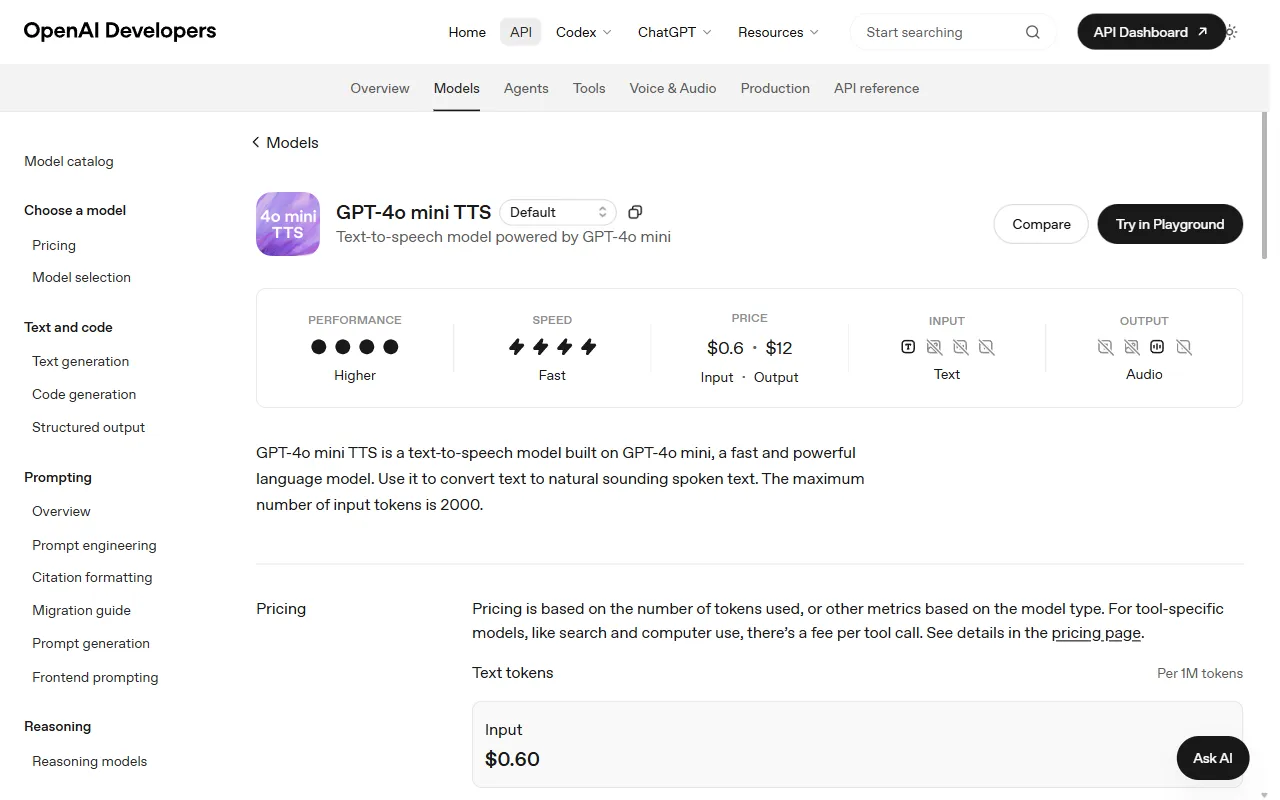
Voices are fixed unless sales says otherwise. The API ships 13 built-in voices, per OpenAI’s TTS guide on 30 September 2026 (it listed 11 in July; our dated capture). OpenAI now offers custom voices, but its custom voices guide is explicit that they are “limited to eligible customers” via the sales team, with a consent recording and a matching sample. If you are an indie developer or a small team wanting a brand voice, that door is not self-serve.
Steering is a prompt, not a spec. There is no SSML and there are no per-word timestamps. Delivery is controlled by a free-text instructions prompt (accent, emotional range, intonation, impressions, speed), which is genuinely expressive and genuinely non-deterministic: the same prompt can read differently across takes, which matters for retakes, captions and anything that must sound identical twice.
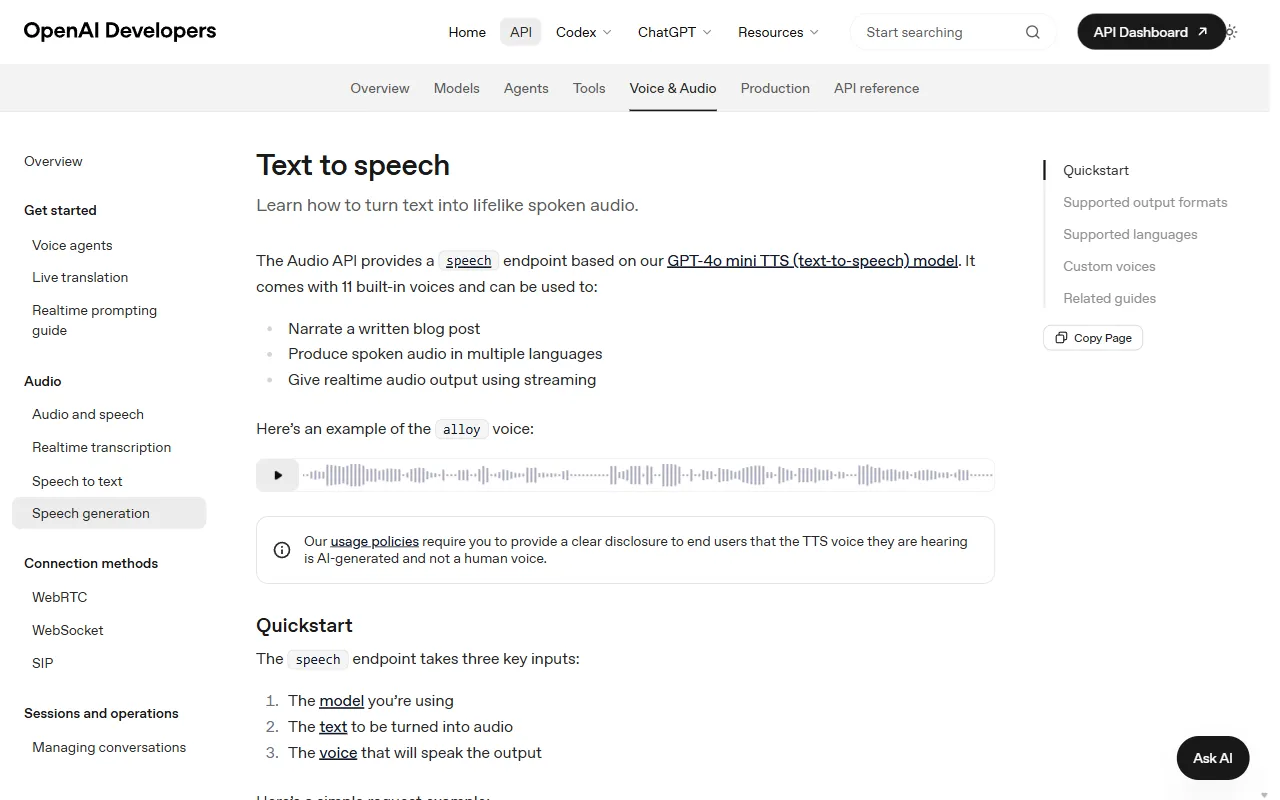
To be fair before moving on: the openai.fm demo remains one of the most open playgrounds in the industry, because it takes your own text and a free-text vibe prompt with no login, where ElevenLabs, Cartesia, Deepgram, Hume and Rime all needed an account or offered only canned samples in this round. It handled my test passage cleanly. OpenAI TTS is not a bad product: gpt-4o-mini-tts streams audio as it generates, returns six audio formats, and its prompt steering is genuinely expressive. It is a convenient default, because the key and the SDK are often already in your stack, with a low ceiling: a 2,000-token request cap, voices you cannot clone yourself, and no SSML or timestamps. The rest of this page is about what is above that ceiling.
How I use benchmark evidence: dated snapshot and limits
The hands-on test on this page remains dated July 2026. For current third-party quality context, use the fixed benchmark snapshot of Artificial Analysis's full provider-voice board, read 23 September 2026, including 95% confidence intervals. On that reading Simba 3.2 scored Elo 1,237 ±14, in the top five of 92 models. Its interval overlaps the models on either side of it, so the board does not establish a decisive winner among them, and the snapshot should not be generalized to voices or providers outside it.
Quick comparison of developer-focused TTS platforms
| Platform | Model tested | Price per 1M chars (API) | Free tier | Commercial use on free tier | Public playground |
|---|---|---|---|---|---|
| SpeechifyAI | Simba 3.2 | $10 (Starter, $10/mo) to $6 (Scale, $499/mo) | 500K chars/mo | Yes | Yes, no login |
| ElevenLabs | Eleven v3 / Flash v2.5 | $80 / $40 | ~10K chars/mo | No | No, login required |
| Cartesia | Sonic-3.6 | $49 (per Artificial Analysis, 23 Sep 2026) | 20K credits (~27 min)/mo | No, Pro ($5/mo) and up | No, login required |
| Deepgram | Aura-2 | $30 | $200 credit, no card | Yes (credit) | Previews only |
| Hume | Octave 2 | $50 to $150 by plan | 10K chars/mo | No, Creator ($14/mo) and up | Login required |
| Rime | Coda | $50 (Starter) | 3,000 minutes | Not stated on pricing page | Canned demos only |
| OpenAI (baseline) | gpt-4o-mini-tts | Token-priced ($0.60 in / $12 audio out per 1M tokens); tts-1: $15 | None (pay as you go) | n/a | Yes (openai.fm), no login |
Prices pulled from each vendor’s live pricing page in July 2026 and re-checked the day this page went live, and ElevenLabs’ re-read on 28 September 2026 after it lowered them; the sources at the bottom are the exact pages I used. Cartesia sells credits rather than characters, so its per-character figure uses Artificial Analysis’ normalization.
The fastest way to pressure-test that table is with real audio: grab a free SpeechifyAI key (500K characters a month, no card) and run your own script through us and OpenAI side by side.
Real-time streaming for web apps: what we measured
For a web app that speaks while it generates, what matters is the wait before the first sound. SpeechifyAI’s POST /v1/audio/stream sends audio over HTTP as it is generated, as PCM, MP3, Ogg Opus or AAC, up to 20,000 spoken characters per request; PCM needs no encoding step. On our production US East streaming path, Simba 3.2 measured 56 ms to first byte at the median and 102 ms at the 90th percentile on 15 Sep 2026; our latency guide explains how that is measured and has scripts to time it from your own code. That is a measurement, not an SLA or guarantee.
In our own open round on 9 Oct 2026, timed from a client in US East over warm connections, Simba 3.2 reached first audible audio in a median of 47 ms over the WebSocket input stream and 64 ms over the HTTP stream. Two independent benchmarks time it from their own runners: Coval measured a 109 ms median time to first audio over the 24 hours to 9 Oct 2026 11:00 UTC, and Voice Arena read 123 ms p50 for its "Simba 3.2 Real-time" row on its US English board on 24 Sep 2026. Their readings include the network to each runner and any silence before the first sound, so they read higher than our production first byte, and neither is its source. The dated snapshots: our round, Coval, Voice Arena.
OpenAI’s gpt-4o-mini-tts streams too, over chunked transfer encoding per its TTS guide, and publishes no first-audio figure of its own. For a browser app, keep the API key on your server, pass the stream through, and play it with the Web Audio API; our browser streaming walkthrough builds exactly that. Use simba-3.2 for English and simba-3.0 for German, Spanish, French, Italian or Portuguese, and time both vendors from where your code runs, since the network is part of what your users hear.
What 10 million characters a month costs
| Provider and model | Cost of 10M characters a month | How it is billed |
|---|---|---|
| SpeechifyAI Simba 3.2 | $91 | Starter plan ($10/month, 1.9M characters included), then $10 per 1M |
| OpenAI tts-1 | $150 | $15 per 1M characters |
| OpenAI tts-1-hd | $300 | $30 per 1M characters |
| OpenAI gpt-4o-mini-tts | Depends on the audio | $0.60 per 1M text tokens plus $12.00 per 1M audio tokens |
| Deepgram Aura-2 | $300 | $30 per 1M characters |
| ElevenLabs Flash v2.5 | $400 | $40 per 1M characters |
| ElevenLabs Eleven v3 | $800 | $80 per 1M characters |
OpenAI’s prices were read from its pricing page on 30 September 2026 (our dated capture); the Deepgram and ElevenLabs rows are from our 28 September 2026 pricing read (our reviewed pricing snapshot), and our pricing-at-volume post has the full table with its sources. ElevenLabs launched Eleven v4 after that read, at the same list prices and 72% off through 12 October 2026. gpt-4o-mini-tts has no per-character price, because the audio tokens a passage produces depend on the audio rather than the text.
1. SpeechifyAI
Yes, our own platform is on the list, and you should treat that with exactly the suspicion it deserves. Here is the case, made entirely from things you can verify without believing a word we say.
The price claim is on our public pricing page: additional usage is $10 per 1M characters on the $10/month Starter plan, $8 on the $99/month Pro plan, and $6 on the $499/month Scale plan, per-character rates you can put in a spreadsheet before you ship. Use the dated benchmark snapshot above for quality context rather than treating a historical leaderboard as a permanent ranking.
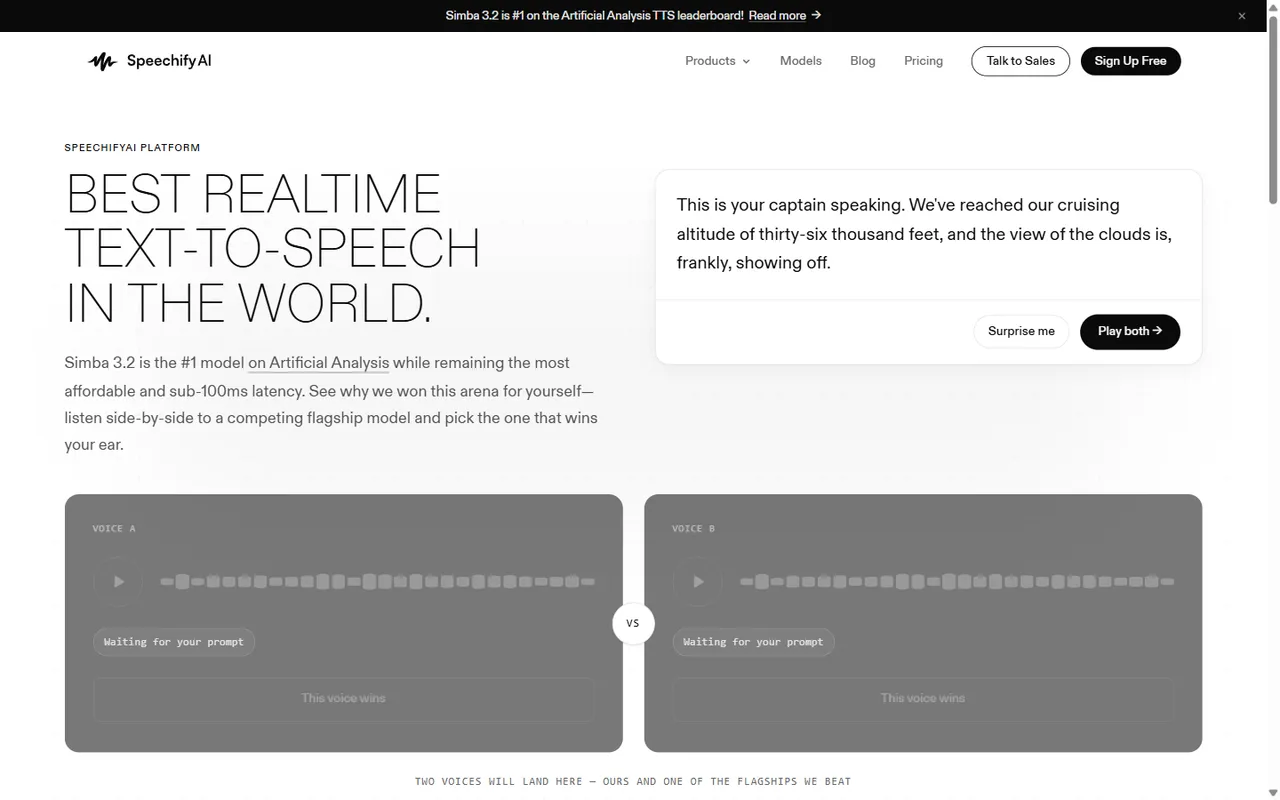
The hands-on test was the easiest of the round, because the speechify.ai homepage is itself a blind test: it plays our synthesis of a passage next to an unlabeled flagship competitor and lets you pick, no account needed.
On voices, we make a different bet than a menu. Simba 3.2 serves the full English voice roster, each voice tuned for a wide dynamic range, so the same voice carries both narration and dialogue, and where OpenAI steers with a prompt and hopes, SSML tags set pauses and speaking rate exactly where you put them. Simba 3.0 covers six self-serve languages across seven locales, English included, with broader coverage available through sales. Instant zero-shot voice cloning starts on the $10/month Starter plan, so the voice that matters most, your brand’s own, is never on anyone else’s menu. If what you actually want is thousands of community voices to browse, ElevenLabs (next on this list) is the honest answer, because its community library lists 10,000+ voices.
The free tier is the one I would point any evaluating developer at, particularly since OpenAI offers none for TTS: 500K characters per month, commercial use included, with a hard cap instead of surprise overages. Grab a free API key and run my test sentence against your current gpt-4o-mini-tts output; the whole evaluation costs nothing.
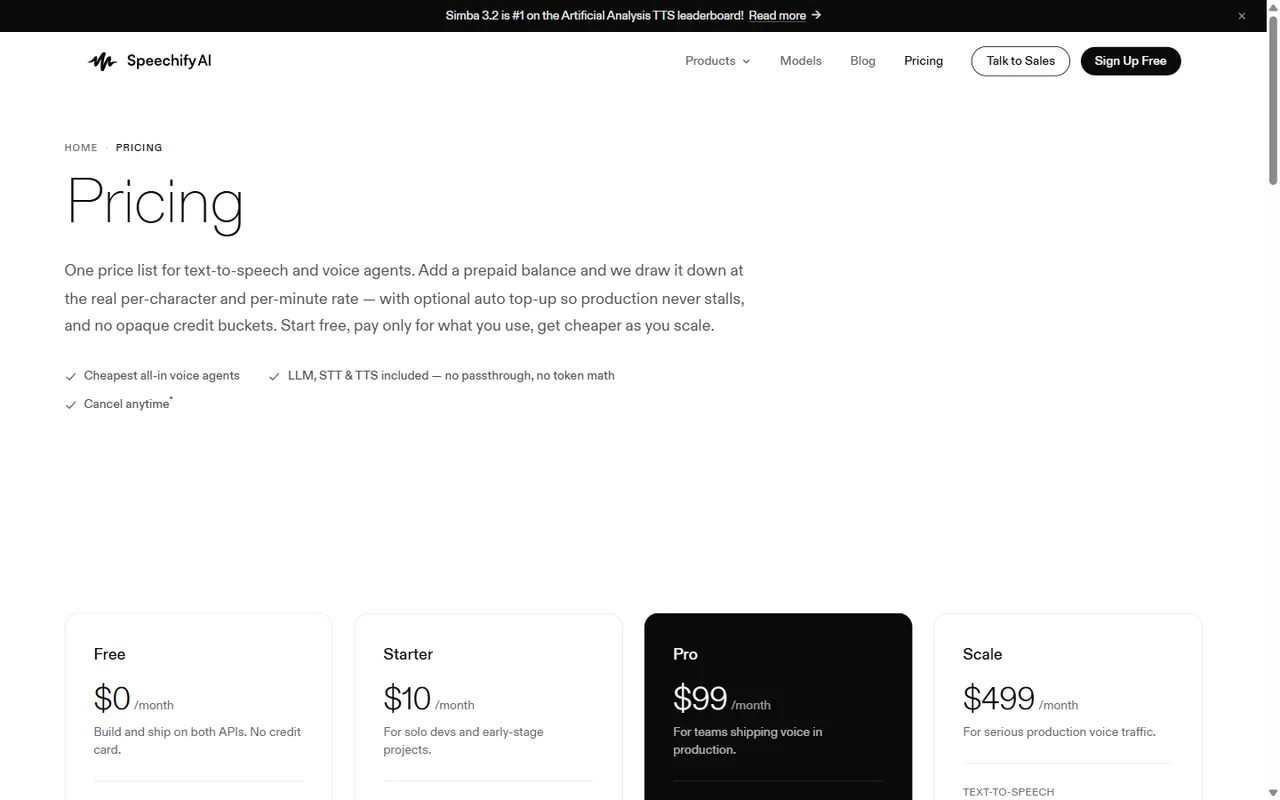
Updated 30 Sep 2026: current latency and cost figures are in the streaming and 10 million characters sections above. The rest of this guide is as tested in July.
Pick SpeechifyAI if: you want forecastable per-character prices or instant zero-shot voice cloning from the $10/month Starter plan. Stay away if: you need thousands of preset voices to pick from on the newest model generation, today.
2. ElevenLabs
If what pushed you off OpenAI is the fixed voice menu and the sales-gated cloning, ElevenLabs is the strongest counter-programming in the industry, because it answers both directly: a 10,000+ community voice library, self-serve instant and professional voice cloning, and an ecosystem (dubbing, music, sound effects, voice changer) nobody else on this list matches.
You pay for all of that in the most literal way. The ElevenAPI pricing page lists Flash/Turbo at $0.04 per 1K characters (about 75ms latency) and Multilingual v2/v3 at $0.08 per 1K on 30 September 2026, which is $40 to $80 per 1M characters, and subscription tiers stack on top (Creator $22, Pro $99, Scale $299, Business $990 monthly). Its new Eleven v4 models list at the same $0.08 and $0.04 per 1K and launched at 72% off through 12 October 2026 (our dated capture). At list prices, coming from OpenAI’s tts-1 at $15 per 1M is a step up in cost, not down; you are buying breadth and cloning, not savings.
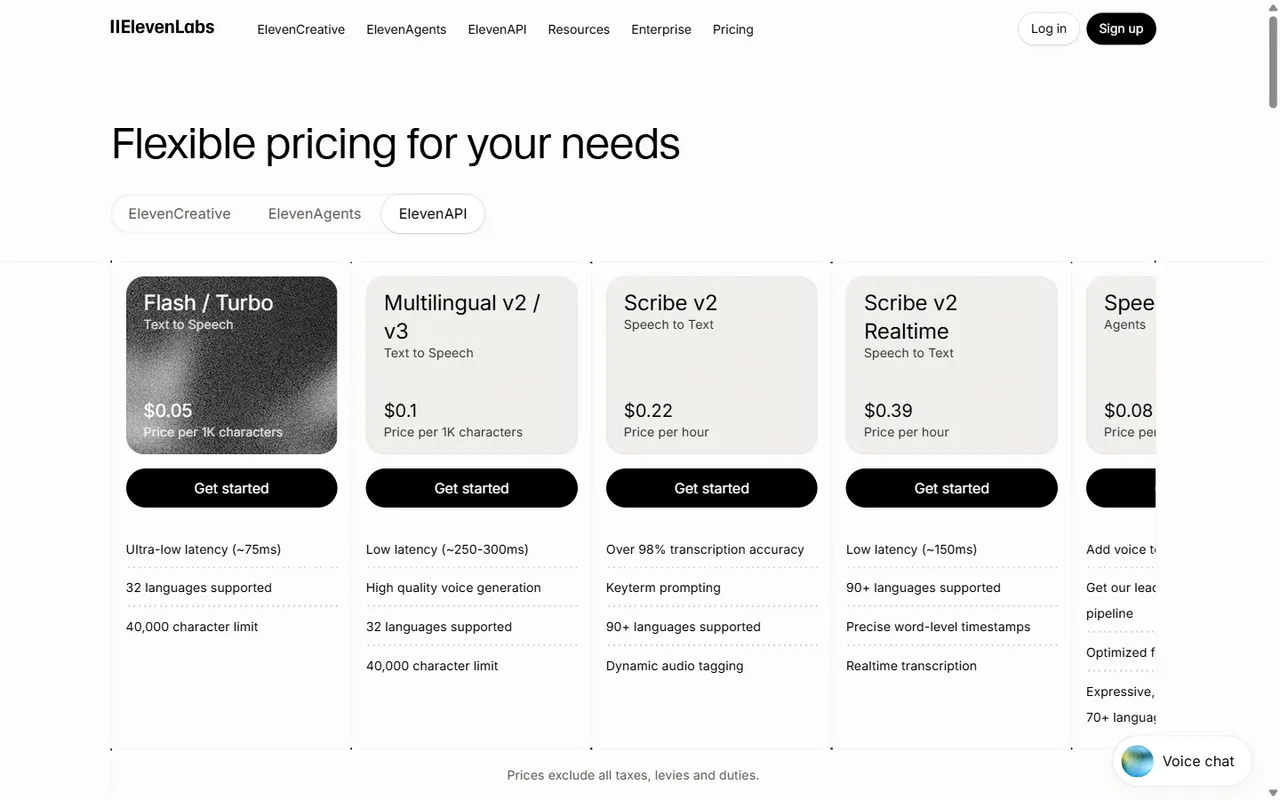
Two testing notes. First, ElevenLabs’ public TTS page would not synthesize my custom passage without an account, so unlike openai.fm you cannot kick the tires anonymously. Second, Flash v2.5 accepts up to 40,000 characters per request (Eleven v3 takes 5,000 and Multilingual v2 10,000, per ElevenLabs’ models docs on 30 September 2026, captured here), against OpenAI’s 2,000 input tokens, which is exactly the kind of spec that decides long-form pipelines. We ran a full alternatives round on ElevenLabs itself if it is the vendor you are actually deciding between.
Pick ElevenLabs if: voice variety and self-serve cloning are why you are leaving OpenAI, and cost per character is not your binding constraint. Stay away if: you were hoping an OpenAI alternative would also be cheaper; at list prices this one is not.
3. Cartesia Sonic
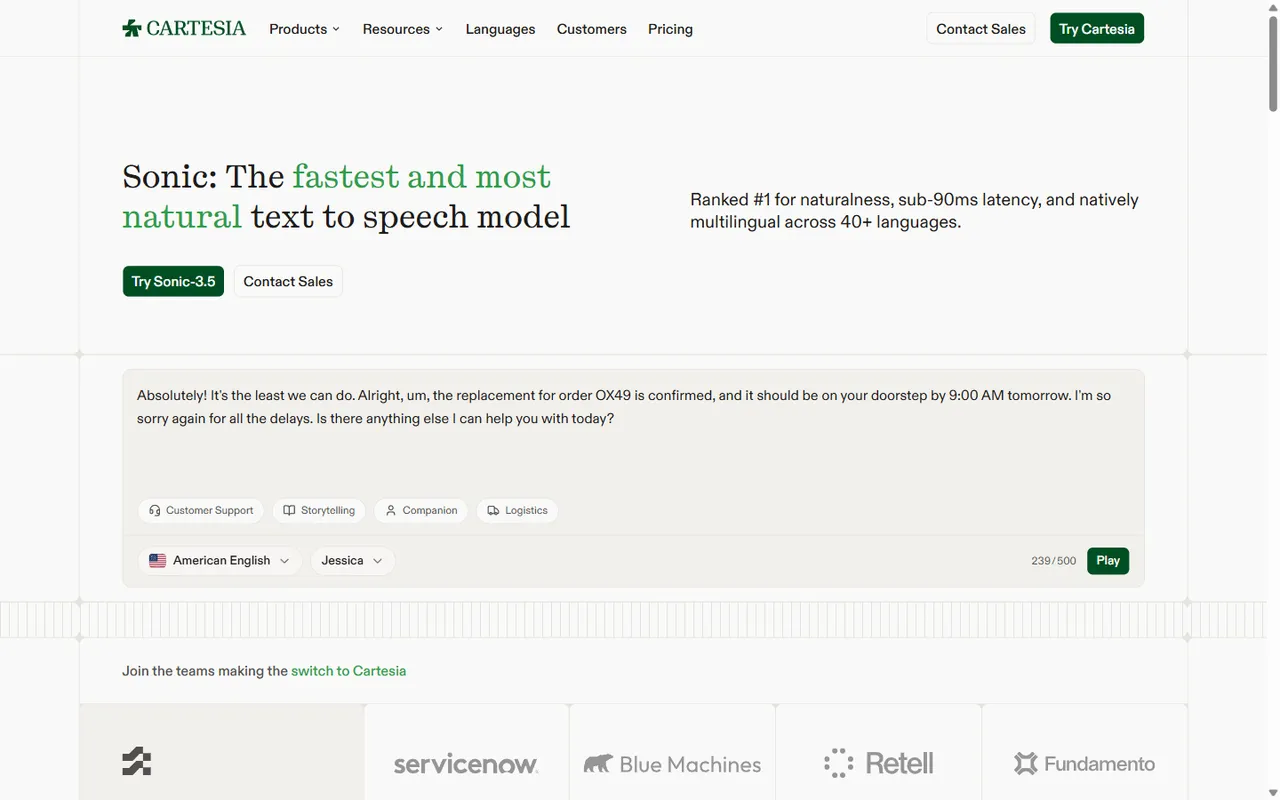
Cartesia is the latency specialist. The Sonic page leads with sub-90ms latency for Sonic-3.6 and 44 languages on 30 September 2026 (our dated capture). If you are building realtime voice agents, this is the specialist alternative to benchmark on your own path.
Hands-on, Cartesia was one of the platforms I could not fully test: play.cartesia.ai redirects straight to a GitHub/Google sign-in, and the public site only offers canned samples.
Pricing is credit-based: Free gets 20K credits a month (about 27 TTS minutes) without a commercial license, Pro at $5/month adds commercial use and instant voice cloning (note: self-serve cloning for five dollars, versus a sales conversation at OpenAI), Startup at $49 covers about 1.25M credits, Scale at $299 about 8M. If Cartesia is the platform you are actually deciding on, our Cartesia alternatives guide covers the field from that side.
Pick Cartesia if: shaving every millisecond off agent response time is your deciding metric and a $5 entry price works. Stay away if: you want to evaluate with your own text before creating an account, or you dislike credit-math billing.
4. Deepgram Aura-2
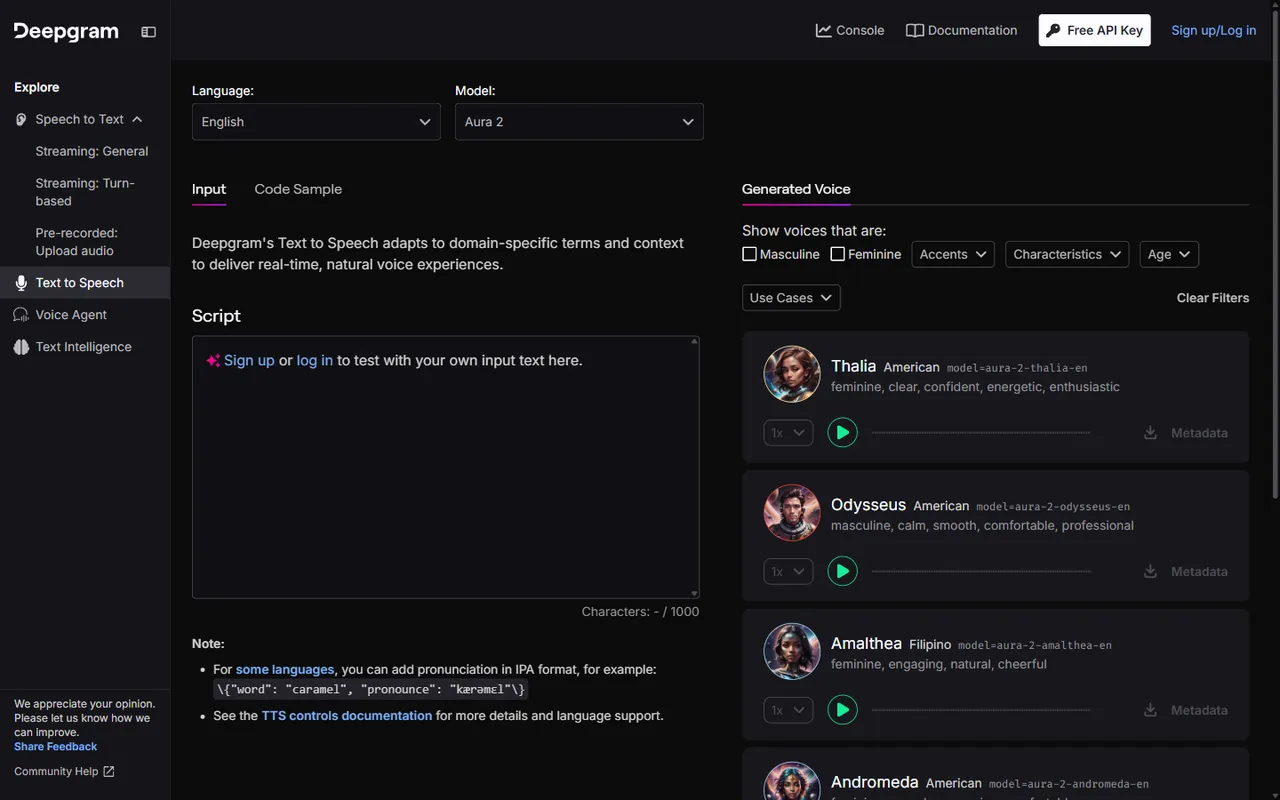
Deepgram is the consolidation play: if you already use them for speech-to-text (many voice-agent teams do), Aura-2 puts synthesis on the same vendor, same console, same invoice. Their playground let me browse and preview the Aura-2 voice list without an account, though typing my own test passage required signing up, halfway between openai.fm’s fully open demo and ElevenLabs’ wall.
Pricing is refreshingly plain, and for anyone tired of estimating audio tokens it reads like relief: Aura-2 costs $0.030 per 1K characters pay-as-you-go ($30 per 1M, the same rate as OpenAI’s legacy tts-1-hd), and every new account gets $200 of usage credit with no credit card, the most generous no-strings trial in this test. The trade-off is scope: 90 voices across seven languages, 41 of them English (Deepgram’s voices docs, 30 September 2026), built to sound professional on a phone line rather than expressive in a story. Deepgram is not part of the dated quality snapshot above, so it does not support a head-to-head quality claim. If Deepgram is the platform you are actually deciding on, our Deepgram alternatives guide covers the field from that side.
Pick Deepgram if: you want STT and TTS from one enterprise vendor with transparent per-character pricing, or $200 of real testing room. Stay away if: you need wide language coverage, a large voice catalog, or third-party quality evidence.
5. Hume Octave
Hume comes at speech from emotion-science research. Octave 2 is built to be directed (“sound like a tired night-shift nurse delivering good news”) rather than just voiced, which sounds like OpenAI’s instructions prompt until you use both: Hume’s whole product, including its EVI speech-to-speech line, is organized around that direction, not offering it as a bolt-on parameter.
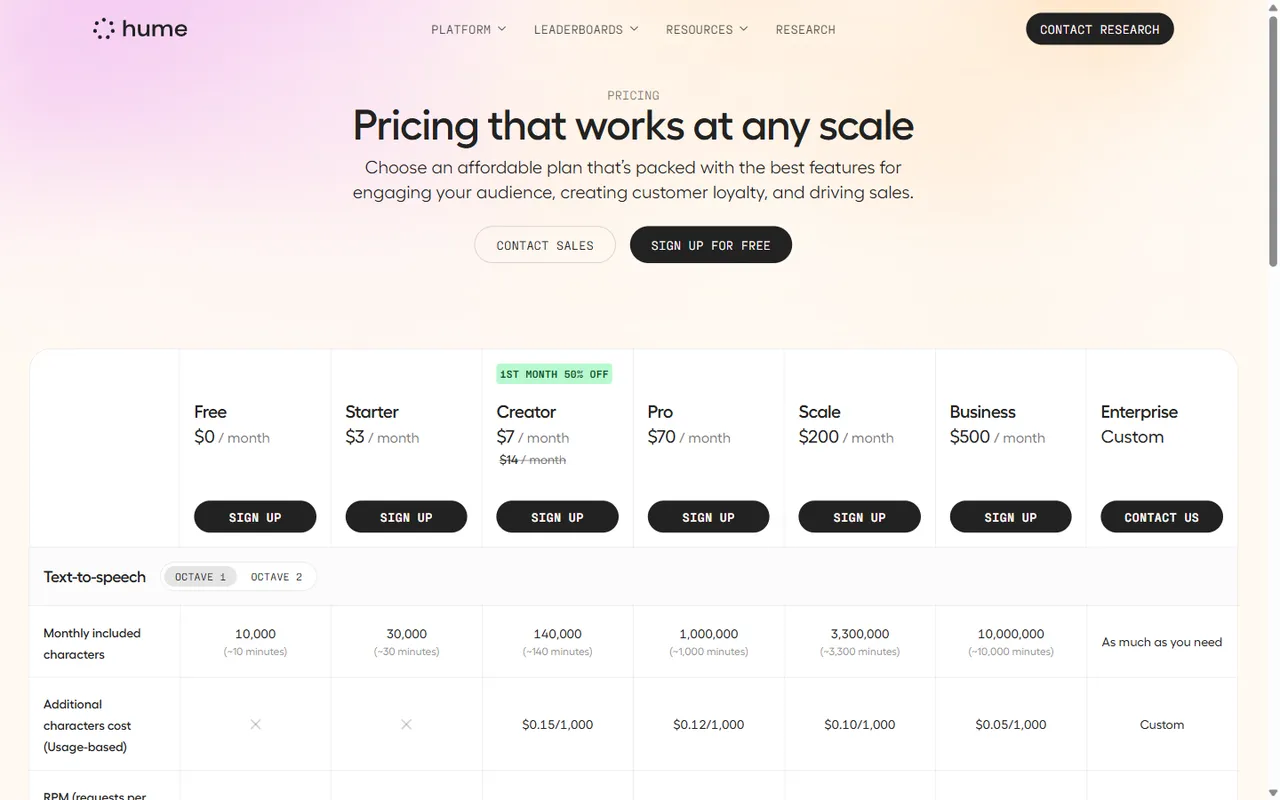
The pricing page is plan-gated: Free gives 10K characters a month, Creator at $14/month gives 140K with overage at $0.15 per 1K, falling to $0.05 per 1K on the $500 Business tier. That works out to $50 to $150 per 1M characters, so Hume costs more than OpenAI for a different specialty, not less for the same one. Unusually, voice cloning is available on every tier including Free. If Hume is the platform you are actually deciding on, our Hume alternatives guide covers the field from that side.
Pick Hume if: emotional direction and empathic voice interaction are the product, not a garnish. Stay away if: you are optimizing cost per character for bulk narration; the math does not favor it.
6. Rime
Rime is the contact-center specialist, founded by linguists and pointed hard at high-stakes phone conversations in healthcare, banking and food ordering. The flagship model, Coda, headlines 600+ voices across 50+ languages, and Rime is the only vendor on this list leading with on-prem and VPC deployment on its pricing page. OpenAI does not offer anything comparable; if your compliance team requires the model inside your network, this is the shortlist.
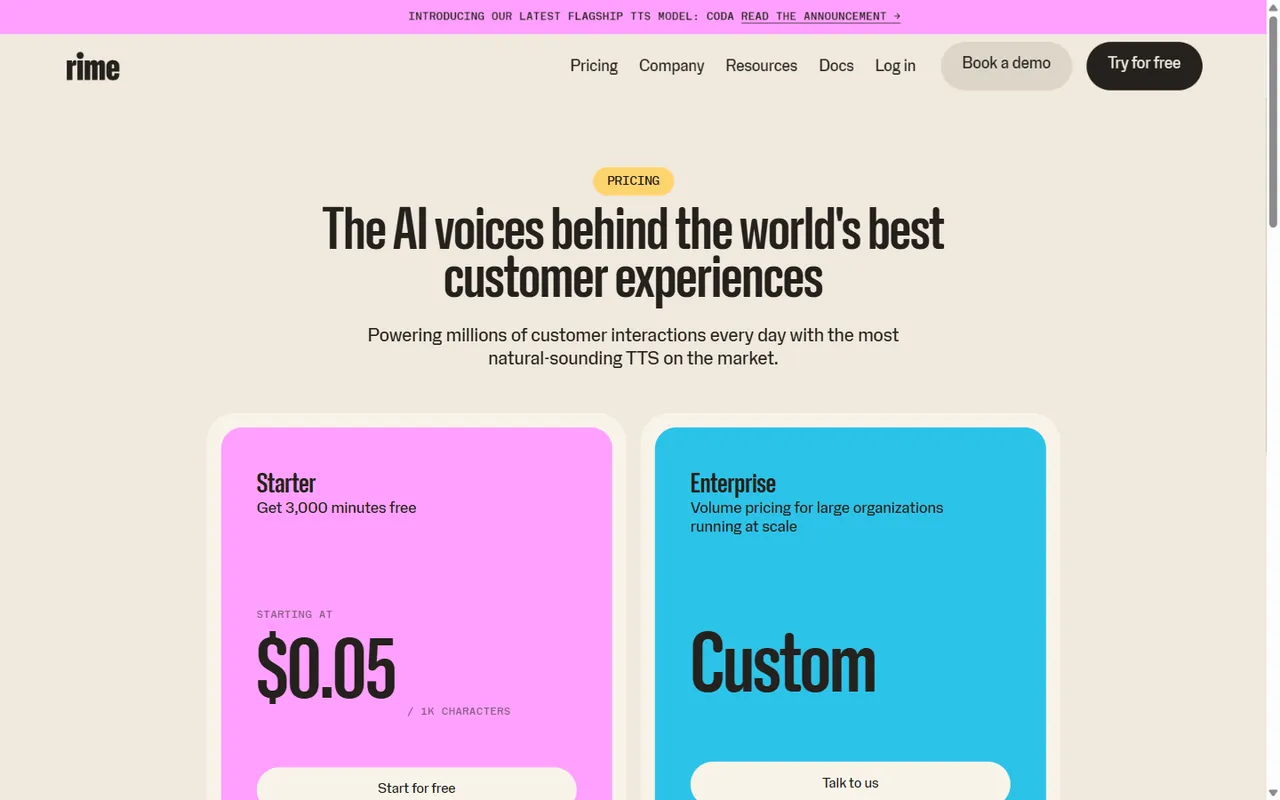
Starter pricing is $0.05 per 1K characters ($50 per 1M) with a properly generous 3,000 free minutes on signup and 20 concurrent generations. The public site only plays canned industry demos, so my test passage went unspoken here, and the positioning is squarely CX rather than narration or characters.
Pick Rime if: you run high-volume customer calls and need deployment control (on-prem/VPC) plus voices tuned for telephony. Stay away if: you want self-serve evaluation with custom text, or creator-style expressive narration.
Also considered, and the PlayHT warning
Google, Microsoft Azure and Amazon Polly all sell capable TTS, and if your company already lives in one of those clouds, procurement gravity may decide for you. We compare them individually on our text-to-speech comparison pages.
And the standing warning for this category: PlayHT appeared on virtually every TTS alternatives list ever written until Meta acquired the PlayAI team in mid-2025, and when we checked this July, both play.ht and play.ai no longer resolve at all. Every team that built on it has been forced off. The voice platform you pick is a dependency; weigh the vendor’s incentive to keep serving developers, not just the demo quality.
Which alternative fits your use case
- Bulk narration, audiobooks, content pipelines: SpeechifyAI. Per-character pricing you can forecast, and 20,000 characters per streaming request instead of a 2,000-token cap.
- Voice variety and brand voices, self-serve: ElevenLabs, with SpeechifyAI as the value option for instant zero-shot cloning from the $10/month Starter plan.
- Real-time speech systems: benchmark SpeechifyAI and Cartesia on your own path; Cartesia remains the specialist option when its model-side latency wins your workload.
- One vendor for STT + TTS: Deepgram. The $200 no-card credit also makes it the cheapest platform to evaluate seriously.
- Emotive characters and empathic interfaces: Hume Octave, priced as a specialty, not a saving.
- Regulated contact centers: Rime, for the on-prem/VPC deployment story alone.
- Staying on OpenAI: defensible if your TTS needs are simple, your volumes are modest, and one fewer vendor genuinely matters. Re-check the math the first time you chunk a long document or ask sales about a custom voice.
Migrating off OpenAI TTS
TTS migrations are usually smaller than teams fear, because the integration surface is thin: one synthesis endpoint, a voice name, an audio format. Leaving OpenAI specifically:
- Re-map the built-in voices first. Shortlist replacements on the new platform and A/B them against your current output with your actual content. If you steered delivery with
instructionsprompts, capture those prompts; on SSML-capable platforms their intent usually translates into explicit tags, which then render the same way every time. - Rebuild your cost model in characters. Token-based audio billing does not map one-to-one onto per-character pricing. Take one month of real OpenAI TTS usage, count the input characters, and price that volume on the alternative’s rate card; it is usually a five-minute spreadsheet that settles the decision.
- Check timestamps and SSML before you commit. OpenAI gives you neither; if captions or word-level alignment are on your roadmap, verify the replacement exposes speech marks. SpeechifyAI’s API docs cover our SSML and speech-marks support.
- Run both in parallel for a week. Mirror a slice of production traffic to the new vendor and diff failure rates, latency and listener feedback. Watch request limits while you do: our Build API caps speech requests at 2K characters and stream requests at 20K, ElevenLabs Flash v2.5 at 40K, and concurrency ceilings differ by plan everywhere.
If you are weighing us specifically against OpenAI feature by feature, the SpeechifyAI vs OpenAI comparison goes deeper on the head-to-head. And the free tier exists precisely so you can rerun every test on this page yourself: sign up free, no card, and your first 500K characters are on us.
The questions behind the switch.
Short answers to the pricing, migration, and product-fit questions that come up after the first side-by-side test.
- What is the best OpenAI TTS alternative for developers in 2026?
- For most production TTS workloads it is SpeechifyAI: it combines predictable per-character pricing, streaming-native synthesis and instant zero-shot voice cloning. If your constraint is different, ElevenLabs leads on voice breadth and self-serve cloning, while Cartesia leads with a claimed model-latency figure.
- How is OpenAI TTS priced, and what does it actually cost?
- gpt-4o-mini-tts is token-priced: $0.60 per 1M text input tokens plus $12.00 per 1M audio output tokens as of July 2026, and the audio output side dominates the bill. The legacy models are per-character: tts-1 at $15 per 1M characters and tts-1-hd at $30. Character-priced alternatives are easier to forecast: SpeechifyAI's additional usage is $10 per 1M on the $10/month Starter plan and $6 on the $499/month Scale plan, while Deepgram Aura-2 is $30 per 1M.
- Does OpenAI TTS support voice cloning?
- Not self-serve. OpenAI added custom voices to its Audio API, but the docs state they are limited to eligible customers and require contacting the sales team, with consent and sample recordings. If you want cloning you can set up yourself today, ElevenLabs, Cartesia (from the $5 Pro plan), Hume (every tier), and SpeechifyAI (instant zero-shot cloning from the $10/month Starter plan) all offer it self-serve.
- Does OpenAI TTS support SSML?
- No. Delivery is steered with a free-text instructions prompt covering accent, emotional range, intonation, impressions and speed. That is expressive but not deterministic: the same prompt can render differently across generations, and there are no SSML tags or per-word timestamps for caption alignment. If you need tag-level control or speech marks, verify support on the alternative before migrating; SpeechifyAI's API documents both.
- Which OpenAI TTS alternative has the best free tier for commercial use?
- SpeechifyAI's free tier includes 500K TTS characters per month with commercial use allowed and a hard spending cap. Deepgram gives $200 of pay-as-you-go credit with no card required. Rime advertises 3,000 free minutes on signup. OpenAI's TTS has no free tier at all; every character is billed pay-as-you-go from the first request.
Every claim should survive your own script.
The free tier is 500K characters of text to speech each month, with commercial use and no card.