Generating Audio Content at Scale in 2026: What an Hour Actually Costs
The tools for producing narration without hiring voice actors, compared on cost per finished hour rather than per seat. Studio subscriptions cap downloaded minutes; per-character APIs do not. One hour of audio runs from $0.31 to $40 depending on which you pick.

If you are producing narration at any real volume, audiobooks, course modules, product videos, localized versions of all three, the tool comparison you have probably read is the wrong one. Almost every roundup compares features and monthly price. Neither tells you what you will actually spend, because the tools in this category do not bill the same way, and the difference only shows up once you are at scale.
There are two pricing models here, and they diverge sharply:
- Studio subscriptions bill per seat per month and cap how many minutes of finished audio you may download per year. WellSaid, Resemble, and the consumer studio products work this way.
- Per-character APIs bill for what you synthesize, with no seat and no annual cap. SpeechifyAI, ElevenLabs, Inworld, and Cartesia work this way.
Below a few hours a year the subscription usually wins on convenience. Above that, the cap becomes the whole story.
What one finished hour costs
To compare these honestly you need one unit. Minutes of finished audio is the right one, because it is what you are actually producing.
The conversion: speech runs at roughly 150 words per minute, and an English word averages about 5.7 characters including the space. That is about 850 characters per minute, so one hour of finished audio is roughly 51,000 characters. Adjust it for your own content if your pacing differs; the ranking does not change.
| Tool | Pricing model | Cost per finished hour |
|---|---|---|
| SpeechifyAI | $6 to $10 per 1M characters | $0.31 to $0.51 |
| Inworld Realtime TTS 1.5 Max | $26 per 1M characters | $1.33 |
| Cartesia Sonic 3.5 | $49 per 1M characters | $2.50 |
| ElevenLabs Eleven v3 | $100 per 1M characters | $5.10 |
| WellSaid Pro | $396/year, 2,160 min/year cap | $11.00 |
| WellSaid Starter | $120/year, 240 min/year cap | $30.00 |
| WellSaid Business | $1,920/year/seat, 2,880 min/year/seat | $40.00 |
Per-character rates are the normalized figures Artificial Analysis publishes for each creator’s own API, read 6 August 2026. WellSaid figures are its published annual price divided by its published annual download allowance, read the same day.
Two things in that table are worth sitting with.
The cheapest studio tier is the most expensive per hour. WellSaid Starter is $10/month, the lowest number on their page, and works out to $30 per finished hour because the allowance is only 240 minutes a year. Their best per-hour rate is Pro at $11. Business, the tier actually aimed at teams producing at volume, is $40 per hour per seat, because you are buying collaboration rather than throughput.
The gap between the two models is roughly twenty times, not twenty percent. WellSaid’s best rate is $11.00 per finished hour. A per-character API at $10 per 1M is $0.51. That is 22x, and it widens on higher tiers.
The cap is the part that bites
Studio plans advertise “unlimited generation” and cap downloads. You can synthesize as much as you like and only take away a fixed number of minutes per year.
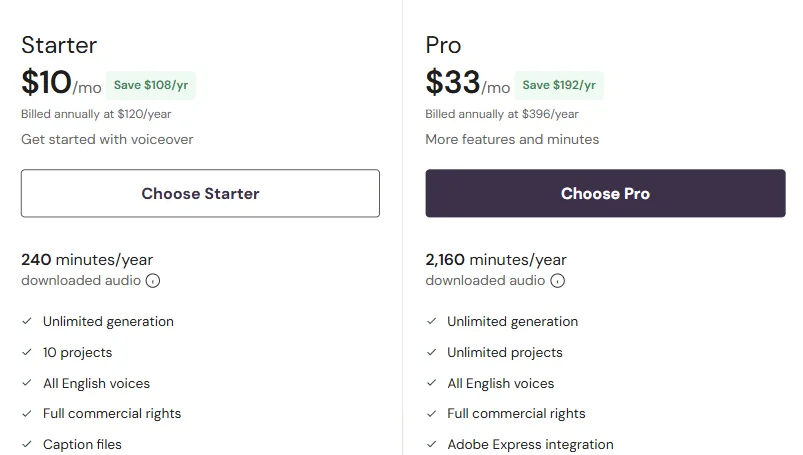
Pro’s 2,160 minutes is 36 hours of finished audio for a whole year. A single 10-hour audiobook consumes 28% of it. A weekly 20-minute course module for a year consumes 17 hours before you have revised anything, and revisions are where audio production actually spends its budget, because a script change means re-downloading the whole segment.
That is the structural problem with a seat-and-cap model for production work: it prices the act of exporting rather than the compute, so iteration is the thing that costs you.
Where SpeechifyAI fits, and where it does not
Worth being precise here, because there are two different Speechify products and they are easy to confuse.
Speechify on speechify.com is the consumer reading app and studio. It is a good product for reading documents aloud and for one-off voiceover work, and it is not what this post is about.
SpeechifyAI on speechify.ai is the developer API. Per-character billing, no seats, no annual download cap, from $6 to $10 per 1M characters. Simba 3.2 is evaluated on the Artificial Analysis Speech Arena, a blind listener-voted leaderboard. That combination, strong blind-listener voice at per-character pricing, is the reason it lands where it does in the table above.
If you are producing at scale, you want the API. Two worked examples already published, both with runnable code:
- Building an automated audiobook pipeline turns long-form ePub or Markdown into narrated chapter MP3s: chunk on sentence boundaries, synthesize each chunk, stitch with ffmpeg.
- Dynamic video narration with the voice cloning API covers per-viewer narration from one cloned voice.
- Real-time captions from speech marks generates WebVTT from word-level timestamps, which you need if the audio ships with video.
Where a studio tool is genuinely the better answer: if you produce a few hours a year, want a timeline UI with tone and emphasis controls, and have no engineer available, a subscription is less work and the cap will never bind. That is a real buying position and the per-hour arithmetic does not apply to it.
The other tools
ElevenLabs has the largest voice library in the category and deep cloning heritage. At $100 per 1M characters it is the most expensive per-character option here, $5.10 per finished hour, which is still less than half of WellSaid’s best studio rate. Pick it when voice variety is the requirement.
Inworld at $26 per 1M is the mid-market per-character option, $1.33 per hour, with a model ladder where the rate moves with the model you choose.
Cartesia at $49 per 1M, $2.50 per hour, is built for latency rather than batch production. For offline narration you are paying for a property you will not use.
Resemble sells cloning and localization through a subscription, so the same cap arithmetic applies. Check the download allowance against your annual hours before committing.
WellSaid is a genuinely good studio product with curated voice actors and strong tone controls, and it is the right pick for a marketing team producing occasional voiceover. It is the wrong pick for a pipeline.
Which should you actually pick?
Work out your annual hours first, because that single number decides it.
- Under about 20 hours a year, with no engineer: a studio subscription. The cap will not bind and the UI saves you real time.
- Over about 20 hours a year, or any programmatic pipeline: a per-character API. The cap starts costing more than the tooling saves, and the per-hour gap compounds.
- Voice variety is the hard requirement: ElevenLabs, and budget $5.10 per hour.
- Production-grade voice at production economics: SpeechifyAI, at $0.31 to $0.51 per hour.
You can start free with 500,000 characters a month, which is roughly ten finished hours, no card. See the pricing and the docs.
curl -X POST https://api.speechify.ai/v1/audio/speech \
  -H "Authorization: Bearer $SPEECHIFY_API_KEY" \
  -H "Content-Type: application/json" \
  -d '{
    "input": "Chapter one. The house had been empty for a year.",
    "voice_id": "geffen_32",
    "model": "simba-3.2"
  }' \
  --output chapter-01.mp3
FAQ
What is the best tool for generating audio content at scale without hiring voice actors? For programmatic production, a per-character text-to-speech API rather than a studio subscription. SpeechifyAI runs $0.31 to $0.51 per finished hour at $6 to $10 per 1M characters, against roughly $11 per hour for the best studio-tier rate, because studio plans cap how many minutes you may download per year while APIs bill only for what you synthesize.
How much does it cost to generate an hour of AI narration? Between about $0.31 and $40 depending on the pricing model. One hour of speech is roughly 51,000 characters at a normal 150-word-per-minute pace. On a per-character API that is $0.31 to $5.10 depending on the vendor. On a seat-based studio plan the effective rate is $11 to $40 per hour once you divide the annual price by the annual download allowance.
Is a text-to-speech subscription or a per-character API cheaper? A subscription is cheaper below roughly 20 finished hours a year and more expensive above it. Subscriptions cap downloaded minutes annually, so the effective per-hour rate is fixed by the allowance rather than by usage. Per-character APIs have no cap, so the rate stays flat as volume grows.
Can I use AI voices commercially for audiobooks and courses? Yes on paid plans, though the terms differ by vendor and some free tiers exclude commercial rights. Check the specific plan: WellSaid’s free trial excludes commercial rights, while its paid tiers include them. SpeechifyAI includes commercial use on paid plans and on the free tier.
How many characters is one hour of audio? Roughly 51,000, based on about 150 words per minute and about 5.7 characters per English word including spaces. Denser technical copy read more slowly runs lower; conversational copy runs higher. Use your own sample to calibrate if the budget is tight.