Artificial Analysis TTS leaderboard: Elo explained, and Simba 3.2's price for its score
On the Artificial Analysis Speech Arena on 13 October 2026, Simba 3.2 scored 1,244 and was the lowest-priced model in the top ten, at $6.60 per million characters against $11 for the next. How the board's Elo works, and two independent latency readings.
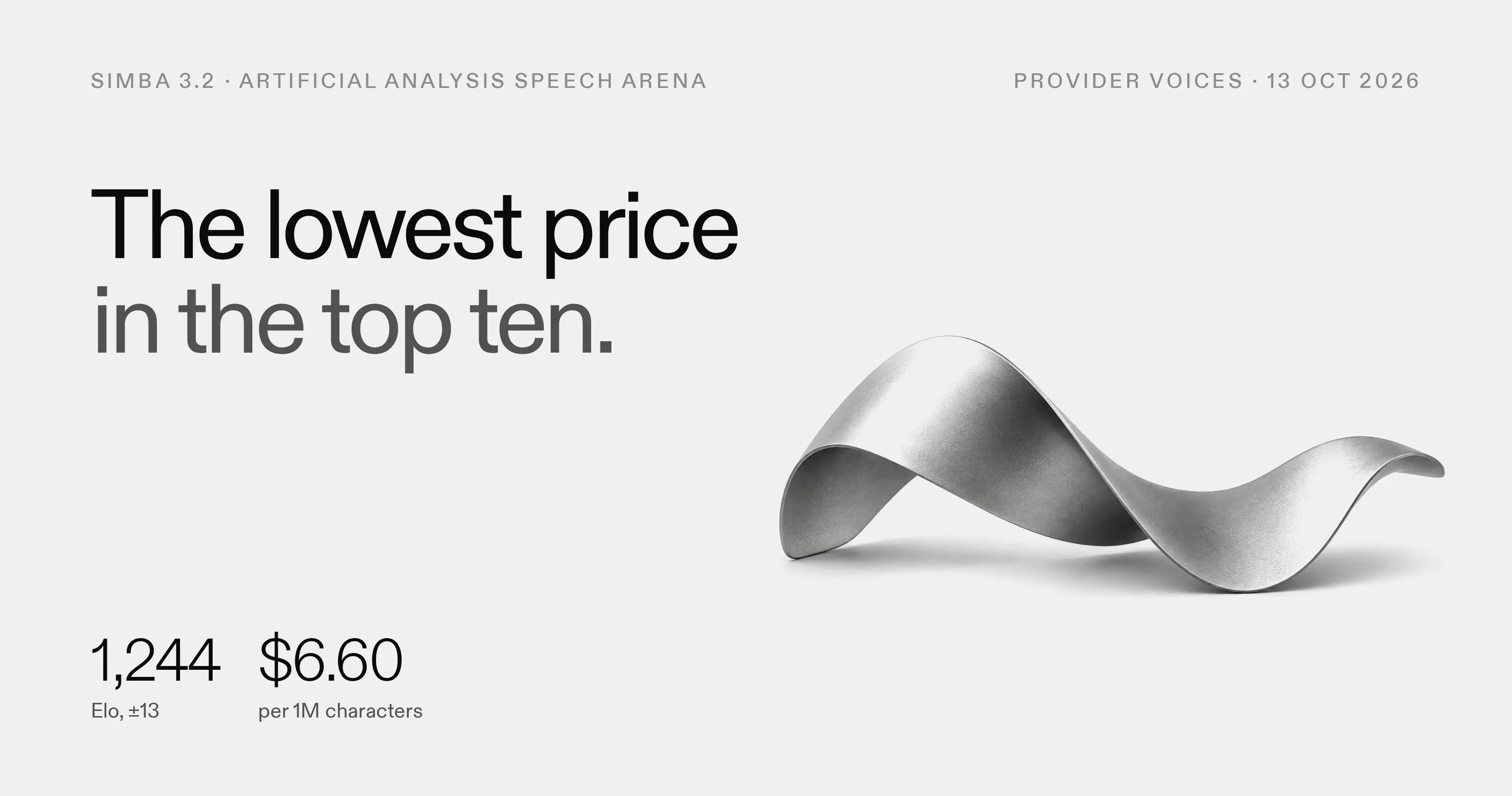
On 13 October 2026, Simba 3.2 scored an Elo of 1,244 (±13) on the Artificial Analysis Speech Arena and was the lowest-priced model in the top ten, at $6.60 per million characters on Artificial Analysis’s normalized prices against $11 for the next lowest (our reviewed snapshot of the board). On those prices, nothing on the board was both cheaper and rated higher, and every model rated above Simba 3.2 cost 1.7 to 12 times as much.
This post is about the leaderboard itself: how the Elo is scored and what a gap between two scores means. For prices across providers at real volumes, read what 1M, 10M and 100M characters a month cost, and to build with the model, start from the Text-to-Speech API.
How the Artificial Analysis Elo works
Artificial Analysis runs a blind speech arena. Listeners hear two clips of the same text from two models, without knowing which model made which, and pick the one they prefer. Every vote moves both models’ ratings, the same Elo method chess uses and the Chatbot Arena made standard for language models. It is not our benchmark and not our numbers.
A gap between two ratings is a head-to-head preference. On 13 October 2026, Simba 3.2 scored 119 points above Simba 3.0, our previous generation, at the same normalized price of $6.60, which means blind listeners pick Simba 3.2 about 66 times in 100 (13 Oct snapshot).
Read the bands before you read the gaps. Artificial Analysis publishes a confidence interval and a rank band beside every score, and on 13 October 2026 two models’ bands overlapped Simba 3.2’s band of eighth to ninth (13 Oct snapshot). The board cannot place either of them above Simba 3.2 with confidence, and they cost 1.7 and 3.2 times as much on the same normalized prices.
Artificial Analysis’s normalized price for Simba 3.2, $6.60 per million characters, is its own estimate and assumes 80% use of a plan (13 Oct snapshot). Our list rates are $10 per 1M characters on Starter, $8 on Pro and $6 on Scale, on the pricing page.
Voice Arena, a second blind board
Voice Arena scores text to speech the same way, with native-speaker panels choosing between two clips of the same text, blind. It runs six languages, a balanced voice slate per model rather than whichever default sounds best, and sentences written for the places TTS actually ships. It also times models to their first audio: on its US English board on 16 October 2026, its “Simba 3.2 Real-time” row read 123 ms at the median (Voice Arena snapshot).
How fast it starts talking
Three numbers, measured three ways.
- Our own first byte. On our production US East streaming path, Simba 3.2 returned its first audio bytes in 56 ms at the median and 102 ms at the 90th percentile, read on 15 September 2026. That is time from our servers, not time to audible audio from your region.
- Coval. Its open benchmark measured a median time to first audio of 109 ms over the 24 hours to 9 October 2026 11:00 UTC, from its own runner, counting the network and any silence before the first audible sample (Coval snapshot).
- Voice Arena. It read 123 ms p50 on its US English board on 16 October 2026, from its own runner (Voice Arena snapshot).
How both benchmarks measure it is in our write-up of their readings, and how to measure it yourself is in our guide to choosing a low-latency TTS API.
Hear it yourself
Check the Artificial Analysis provider-voice leaderboard and vote on Voice Arena, then try Simba 3.2 with a free API key on your own text.
Common questions
Where does Simba 3.2 stand on the Artificial Analysis TTS leaderboard?
How is the Artificial Analysis TTS Elo calculated?
How fast is Simba 3.2?
This post is narrated by Harper on Simba 3.2 through our text to speech API. How the player works: add read-aloud to your docs and turn speech marks into captions.